
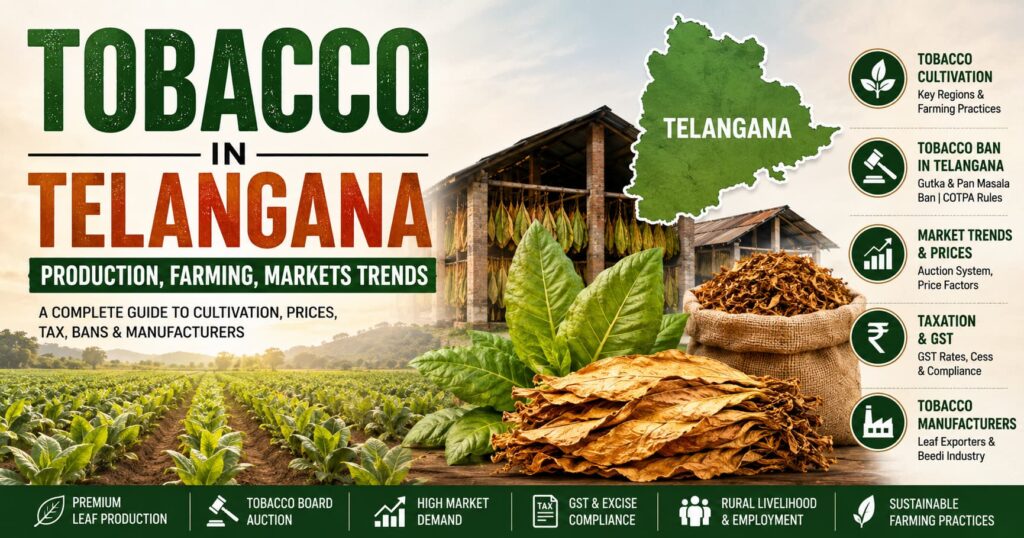

Introduction to Tobacco in Telangana
Commercial agriculture forms the foundation of rural livelihoods across southern India. Among non-food cash crops, tobacco in Telangana holds a strategic position due to its export potential, high market liquidity, and labor-intensive supply chain. For decades, farming communities across the Godavari and Krishna river basins have cultivated diverse tobacco varieties, aligning traditional agronomic wisdom with modern Tobacco Board guidelines.
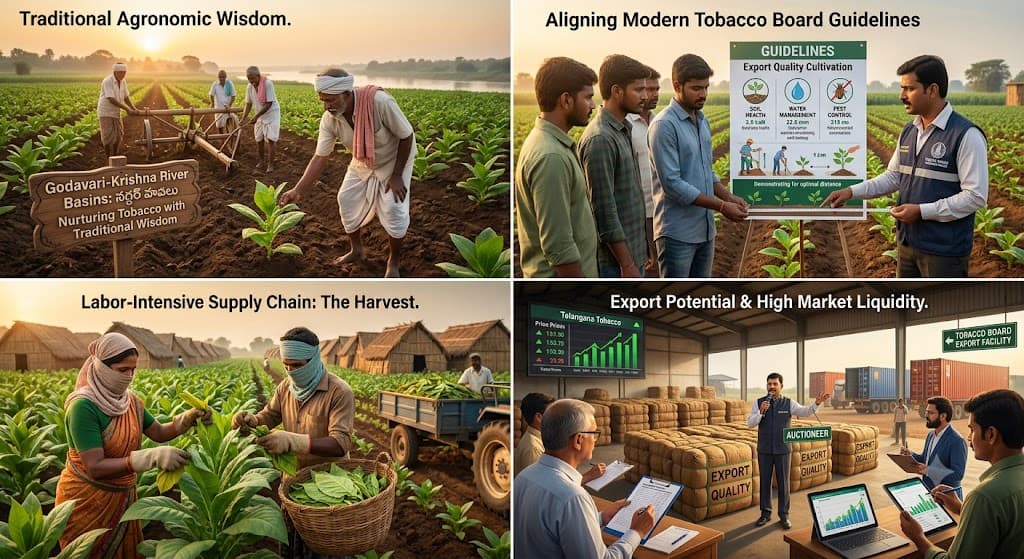
Tobacco belongs to the Solanaceae (nightshade) plant family. In Telangana, production spans Flue-Cured Virginia (FCV) tobacco used primarily for export and cigarettes, along with non-FCV varieties such as Natu, Burley, and Bidi tobacco.
Navigating the complete landscape of tobacco requires understanding every link in the chain: from field management and state bans to auction prices, excise taxation, and industrial manufacturing units.
Tobacco Cultivation in Telangana: Agronomic Breakdown
Tobacco cultivation in Telangana requires precise soil conditions, controlled moisture, and disciplined crop management. Mismanaging a single growing phase—such as overwatering during leaf maturation—can degrade leaf quality and market value.
Key Agricultural Steps
- Nursery Preparation: Farmers raise seedlings in sterile, raised beds or tray setups for 45 to 50 days. This protects fragile young shoots from soil-borne pathogens before field planting.
- Field Transplanting: Seedlings are planted on raised soil ridges during the post-monsoon window (October to November). Ridge planting protects roots from waterlogging during sudden rainfall events.
- Topping and Desuckering: When plants enter the flowering phase, terminal flower buds are removed (topping). This diverts plant energy into broadening the lower leaves and increasing nicotine content.
- Priming (Harvesting): Tobacco leaves mature sequentially from the bottom of the stalk upwards. Farmers harvest leaves in passes (priming) every 6 to 8 days.
- Curing: Primed leaves undergo controlled curing in specialized brick barns or sun-drying racks to transform green leaves into golden, high-grade tobacco.
“Rigorous field management and precise curing temperatures determine whether a harvest yields top-grade commercial leaf or low-value industrial scrap.” — Agronomic Extension Guidelines
Key Tobacco Growing Regions in Telangana
Soil composition and microclimates across Telangana dictate which tobacco varieties thrive best in each region.
Major Farming Belts
- Khammam & Bhadradri Kothagudem: Known as the primary belt for high-grade FCV and light-textured leaves. Sandy loam soils near the Godavari basin provide natural drainage ideal for root expansion.
- Mahabubabad & Warangal: Recognized for Natu tobacco cultivation. The local red gravelly and medium-black soils yield darker, heavier leaves preferred for traditional tobacco products.
- Nizamabad & Karimnagar: Focus heavily on non-FCV leaf varieties, supplying raw tobacco materials to the extensive regional beedi rolling industry.
| District | Primary Soil Type | Tobacco Variety Grown | Curing Method |
| Khammam | Sandy Loam / Light Red | Flue-Cured Virginia (FCV) | Flue Curing (Heat Barns) |
| Bhadradri Kothagudem | Alluvial / Sandy Soil | FCV & Air-Cured Leaf | Flue & Sun Curing |
| Mahabubabad | Medium-Black Soil | Natu & Burley Tobacco | Air & Sun Curing |
| Nizamabad | Red Gravelly Soil | Bidi Tobacco | Sun Curing |
Tobacco Ban in Telangana: Public Health Regulations
While leaf cultivation remains an essential agricultural trade, the state government maintains strict health policies regarding consumer tobacco products. Understanding the tobacco ban in Telangana is vital for consumers, retailers, and distributors.
1. Statewide Gutka and Pan Masala Ban
Under the Food Safety and Standards (Prohibition and Restriction on Sales) Regulations, the Telangana government enforces a complete statewide ban on the manufacture, storage, distribution, transportation, and sale of gutka and pan masala containing tobacco or nicotine.
This prohibition is renewed annually under public health mandates to combat oral health risks, oral submucous fibrosis, and cancer. Food safety inspectors conduct regular market raids to prevent contraband sachets from entering retail supply chains.
2. COTPA Implementation
The Cigarettes and Other Tobacco Products Act (COTPA) enforces additional public consumption rules across the state:
- Smoke-Free Public Spaces: Smoking inside public offices, educational institutions, healthcare facilities, and public transport is illegal.
- School Buffer Zones: Selling tobacco products within 100 yards of any educational institution is strictly prohibited.
- Point-of-Sale Warnings: Retail points must display prominent graphic health warnings and prohibit sales to individuals under 18 years of age.
Tobacco Price in Telangana: Market Dynamics and Auctions
The wholesale tobacco price in Telangana fluctuates based on global supply expectations, Tobacco Board auction quotas, leaf grade quality, and weather conditions during the curing season.
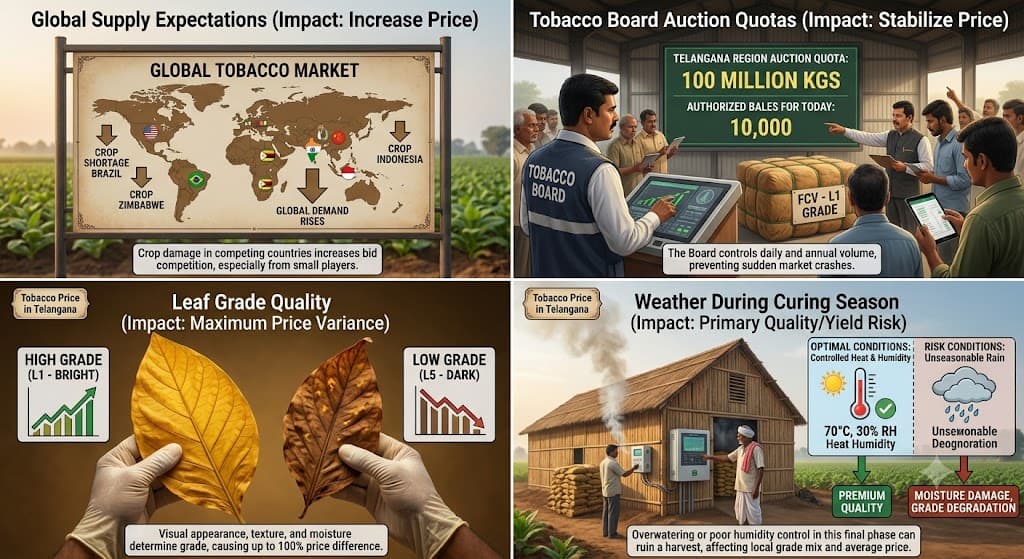
For FCV tobacco, prices are established on authorized Tobacco Board auction platforms. Buyers from major domestic cigarette companies and international leaf export agencies bid directly on cured leaf bales.
Factors Influencing Leaf Prices
- Grade and Color Uniformity: Bright, lemon-yellow leaves with low blemish counts command top-tier auction prices, whereas dark or spotty leaves fetch lower returns.
- Moisture and Chemical Balance: Bales tested for balanced nicotine-to-sugar ratios and clean pesticide residue profiles fetch premium export prices.
- Weather Disruptions: Unseasonal Bay of Bengal rains during the curing cycle can damage leaf texture, temporarily driving up spot prices for undamaged high-grade stock.
Tobacco Tax in Telangana: GST and Cess Structure
Tobacco products fall under India’s highest tax brackets. Navigating tobacco tax in Telangana involves managing both central Goods and Services Tax (GST) rates and additional national compensation cesses.
Tax Breakdown Across Supply Chain
- Unmanufactured Tobacco: Raw leaf trading carries specific GST rates designed to support agricultural supply chains while preserving tax compliance. Discussions at national GST Council meetings regularly review rates on unmanufactured leaf bound for export to protect farmer margins.
- Manufactured Cigarettes and Commercial Products: Standard manufactured tobacco products carry a peak 28% GST rate (with proposals for up to 40% on sin goods), supplemented by heavy tiered compensation cesses based on cigarette length or product volume.
- Input Tax Credit (ITC): Licensed manufacturers operating within legal industrial zones can claim ITC on raw materials, packaging, and processing equipment used for taxable outputs, subject to strict HSN compliance.
| Product Category | Tax Level | Applicable GST / Cess Structure |
| Unmanufactured Tobacco Leaf | Agricultural / Wholesale | Standard Base GST (Subject to Export Reimbursements) |
| Cigarettes | Retail / Finished Good | 28% Base GST + Length-Based Specific Compensation Cess |
| Bidis | Commercial Goods | Standard GST Rate (Lower Cess Bracket compared to Cigarettes) |
| Smokeless / Chewing Tobacco | Regulated / Prohibited | 28%+ Base GST + Ad-Valorem Compensation Cess |
Tobacco Manufacturers in Telangana
The ecosystem of tobacco manufacturers in Telangana spans two distinct sectors: large industrial leaf-processing facilities and traditional unorganized beedi manufacturing units.
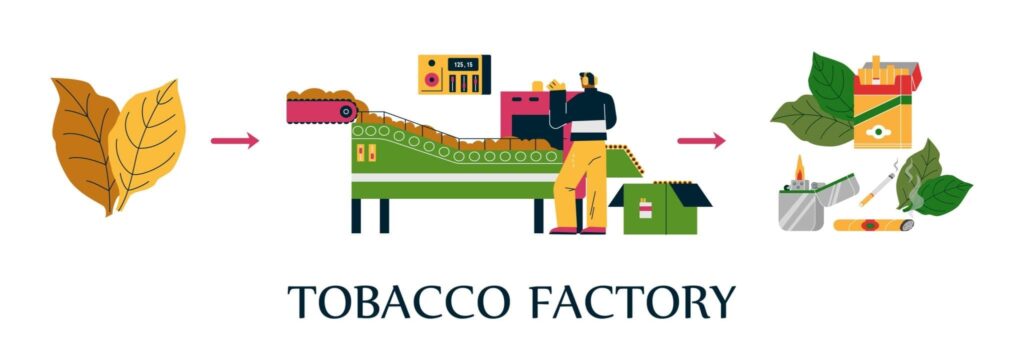
1. Leaf Exporters and Processing Plants
Major commercial leaf processors and export houses operate out of industrial centers around Hyderabad, Rangareddy, and Khammam. These facilities feature automated leaf threshing, redrying, and vacuum packing machinery designed to prepare tobacco bales for shipment to global manufacturers across Europe, Asia, and the Middle East.
2. Traditional Beedi Manufacturing Units
Northern districts—including Karimnagar, Nizamabad, Jagtial, Koratla, and Warangal—house traditional beedi manufacturing enterprises. These operations rely on thousands of rural home-based workers who hand-roll raw tendu leaves filled with processed bidi tobacco mixtures.
While automation has transformed large-scale leaf processing, the beedi sector remains a significant source of supplementary rural income for women across northern Telangana
Sustainable Practices and the Future of Telangana Tobacco
To balance economic productivity with environmental health, agricultural agencies promote sustainable growing protocols across Telangana’s farming districts.
Integrated Pest and Soil Management
- Green Manuring: Rotating tobacco crops with green manure pulses like Sunhemp restores natural nitrogen to sandy soils and reduces dependency on synthetic fertilizers.
- Biological Pest Control: Utilizing pheromone traps and planting marigold border rows reduces insect infestation while minimizing chemical pesticide residues on cured leaves.
- Energy-Efficient Barns: Installing Venturi furnaces and thermal roof insulation inside curing barns reduces fuelwood consumption by up to 30%, lowering curing costs and conserving local forest wood resources.
Conclusion
Understanding tobacco in Telangana requires evaluating a multifaceted economic landscape. While tobacco cultivation in Telangana provides agricultural revenue across eastern and northern farming belts like Khammam and Warangal, state health policies enforce a firm tobacco ban in Telangana on chewable gutka and pan masala to safeguard public health.
At the same time, wholesale tobacco price in Telangana and tobacco tax in Telangana continue to shape financial returns for both farm households and licensed tobacco manufacturers in Telangana. By combining sustainable field practices with regulatory compliance, the state’s agricultural sector maintains an essential balance between economic viability and public health priorities.