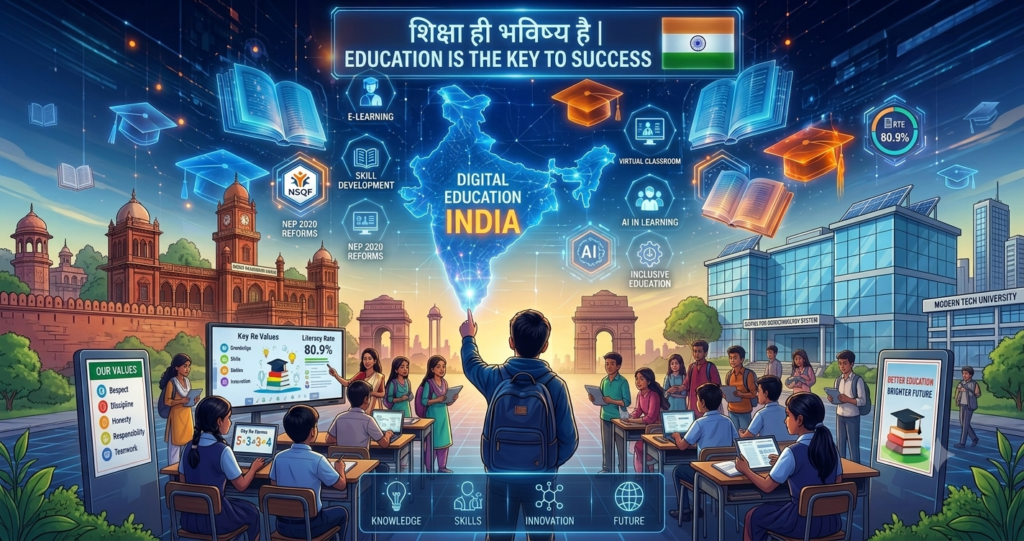

With over 250 million school-going students and a network of more than 58,000 higher education institutions, India holds one of the largest educational ecosystems on Earth. According to the Periodic Labour Force Survey (PLFS), India’s national literacy rate reached 80.9%, marking a historic milestone in the country’s socio-economic development.
However, scaling a system that serves a population of 1.4 billion people comes with complex demands. The Indian education system is currently undergoing a massive structural shift—moving away from traditional rote-memorization models toward flexible, skill-based, and technology-driven learning frameworks.
This detailed guide breaks down the complete architecture of education in India, evaluating its structural levels, structural reforms under NEP 2020, ongoing challenges, and emerging career opportunities.
Overview and Structure of the Indian Education System
The governance of education in India operates under a concurrent model, meaning both the Central Government and individual State Governments share legislative authority. At the central level, the Ministry of Education (MoE) formulates overarching policies, supported by bodies like the National Council of Educational Research and Training (NCERT).
Core Pillars of the Indian Education Architecture
| Educational Sector | Focus Area | Key Regulatory & Operational Bodies |
| School Education | K-12 Curricula & Schooling | CBSE, ICSE, State Boards, NCERT |
| Higher Education | Undergraduate, Postgraduate & Research | UGC, AICTE, AIU, Central & State Universities |
| Vocational & Skill Development | Technical Training & Job Readiness | ITIs, Polytechnics, NSDC, NCVT |
Key Regulatory Governing Bodies
| Educational Tier | Primary Governing / Regulatory Bodies | Core Function |
| School Education | CBSE, CISCE, State School Boards, NCERT | Curriculum design, board examinations, and pedagogical standards. |
| Higher Education | University Grants Commission (UGC) | Maintaining academic standards and funding public universities. |
| Technical & Professional | AICTE, National Medical Commission (NMC), Bar Council | Regulating engineering, management, medical, and legal degrees. |
| Skill Development | National Skill Development Corporation (NSDC), NCVT | Overseas vocational education and industry-aligned skill certification. |
Levels of Education in India
The traditional academic path in India spans four distinct phases, progressing from foundational schooling to specialized research degrees.
1. Foundational & Primary Education
Primary education targets children between the ages of 6 and 14, legally guaranteed by the landmark RTE Act (Right to Education Act, 2009). The primary focus at this stage is developing basic reading comprehension, writing capability, and foundational mathematical logic.
2. Secondary & Higher Secondary Education
Secondary school covers classes 9 through 12. During higher secondary years (Classes 11 and 12), students traditionally choose specific academic tracks:
- Science: Physics, Chemistry, Mathematics, Biology (geared toward engineering and medical entrances like JEE and NEET).
- Commerce: Accountancy, Business Studies, Economics, and Applied Mathematics.
- Humanities / Arts: History, Political Science, Sociology, Psychology, and Literature.
3. Higher Education in India
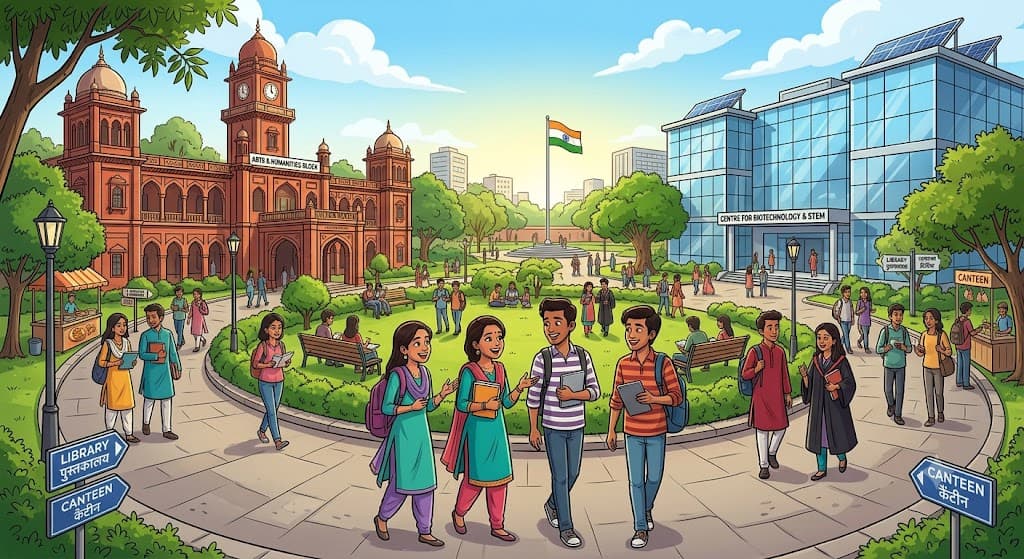
Higher education in India is one of the most complex university networks globally. It comprises Central Universities, State Universities, Deemed Universities, and Private Institutions.
Institutional Breakdown in Higher Education
| Category | Description | Prominent Examples |
| Institutions of National Eminence | Premier public institutes focusing on engineering, management, and medicine. | IITs, IIMs, AIIMS, NITs, IISc |
| Central & State Universities | Public universities funded by central or state government grants. | Delhi University (DU), JNU, Mumbai University |
| Private & Deemed Universities | Independent degree-granting institutions focused on specialized education. | BITS Pilani, Manipal, Amity University |
NEP 2020 Overview: The Modern Reform Engine
The National Education Policy (NEP 2020) represents the most radical set of education reforms in India in over three decades, officially replacing the outdated 1986 framework. Built upon five guiding pillars—Access, Equity, Quality, Affordability, and Accountability—NEP 2020 seeks to transform India into a global knowledge superpower.
“The National Education Policy 2020 shifts the focus of learning from ‘what to think’ to ‘how to think’, replacing rigid academic streams with multidisciplinary flexibility and experiential learning.”
The New 5+3+3+4 Curricular Structure
NEP 2020 completely retired the traditional 10+2 school framework, replacing it with an age-appropriate 5+3+3+4 pedagogical structure:
| Stage | Grades Included | Age Group | Focus of Pedagogy |
| Foundational Stage | 3 years Pre-school / Anganwadi + Grades 1–2 | 3–8 Years | Play-based, activity-focused learning, and fundamental literacy. |
| Preparatory Stage | Grades 3–5 | 8–11 Years | Interactive classroom learning, basic reading, writing, and arithmetic. |
| Middle Stage | Grades 6–8 | 11–14 Years | Experiential learning in sciences, mathematics, humanities, and coding. |
| Secondary Stage | Grades 9–12 | 14–18 Years | Multidisciplinary study, critical thinking, and flexible subject choices. |

Structural Comparison: Old vs. New School Model
| Framework Aspect | Former 10+2 Model | New NEP 5+3+3+4 Model |
| Pre-school Integration | Not formally integrated in state schooling. | 3 years of early childhood care (Ages 3–6) built-in. |
| Academic Stream Choice | Strict streams (Science, Commerce, Arts) in Class 11. | Multidisciplinary choices across arts, sciences, and vocational streams. |
| Skill Inclusion | Limited or optional after Class 10. | Mandatory vocational education introduced in Grade 6. |
Major Highlights of NEP 2020 Reforms
- Multiple Entry and Exit Points: Undergraduate degree programs now offer certificate exits after Year 1, diploma exits after Year 2, bachelor’s degrees after Year 3, and research degrees after Year 4.
- Academic Bank of Credits (ABC): A digital repository that stores earned academic credits, enabling seamless student transfers across universities.
- Vocational Integration: Mandatory introduction to vocational education and practical crafts from Grade 6 onward.
- Mother Tongue Instruction: Promoting education in regional languages and mother tongues up to Grade 5 to improve comprehension.
Key Challenges Facing Indian Education
Despite notable progress in school enrollments, systemic hurdles continue to impact the quality and equality of education in India.
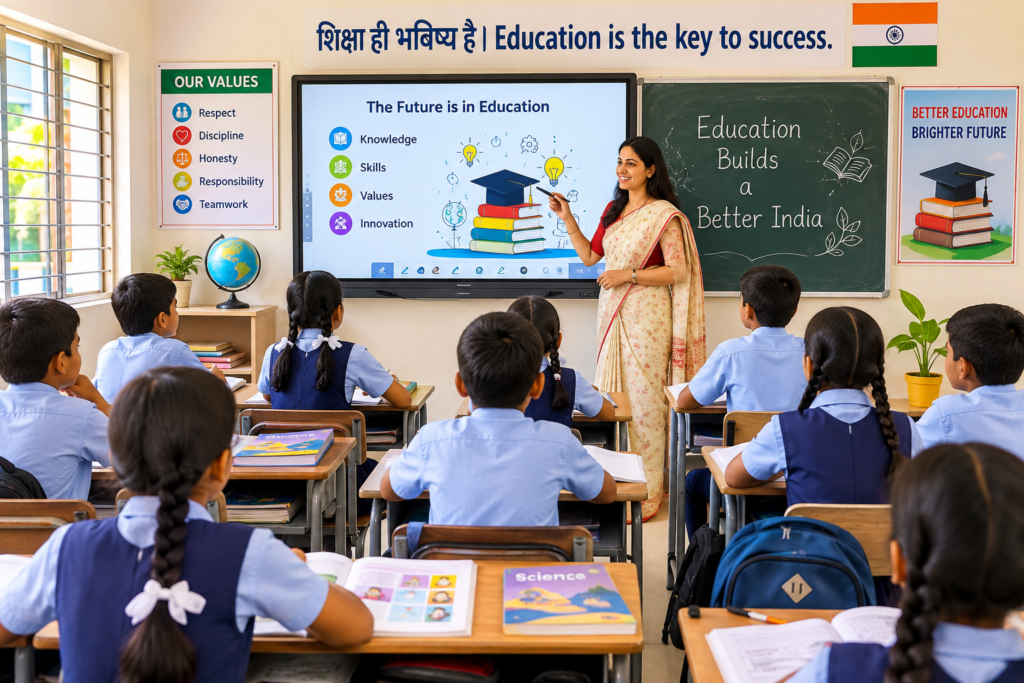
- Rote Learning Dominance: Traditional assessment models continue to prioritize memorization over conceptual problem-solving skills.
- Skill Mismatch & Employability: A significant proportion of engineering and general graduates lack job-ready technical and soft skills required by modern industries.
- Inadequate Education Infrastructure: Many rural institutions face shortages of functional laboratories, digital devices, electricity, and clean sanitation facilities.
- Teacher-Student Ratio Gaps: Shortages of trained educators, particularly in interior rural sectors, impair personalized learning outcomes.
- Socio-Economic Disparities: Wealth, regional location, and gender gaps still create barriers to accessing high-quality higher education in India.
Opportunities for Improvement & The EdTech Revolution
The rapid growth of digital education has created unprecedented avenues to democratize access and bridge historical equity gaps across the country.
Drivers of Educational Transformation
| Growth Driver | Transformation Area | Practical Impact |
| EdTech Platforms | Mobile Learning & AI | Provides low-cost access to quality entrance coaching and interactive modules. |
| Skill Development | Vocational Training | Aligns university curricula with practical industry internships and certifications. |
| Inclusive Education | Equity & Accessibility | Offers specialized digital tools for students with special needs and gender inclusion grants. |
1. The Expansion of EdTech and Hybrid Learning
India’s EdTech ecosystem has emerged as a global innovation hub. Low-cost smartphone technology and affordable high-speed internet allow students in Tier-2, Tier-3, and rural areas to access top-tier entrance coaching, interactive science modules, and dynamic learning tools online.
2. Focus on Skill Development & Apprenticeships
To boost youth employability, educational frameworks are aligning directly with the National Skills Qualifications Framework (NSQF). Integrating mandatory industry internships and practical workshops ensures students graduate with marketable skill sets.
3. Promoting Inclusive Education
Modern government policies focus heavily on inclusive education, introducing accessible digital infrastructure for students with special needs (Divyangjan), targeted scholarships, and dedicated Gender-Inclusion Funds for socio-economically disadvantaged groups.
[Insert Internal Link to EdTech Innovations Guide]
Major Government Initiatives
To accelerate learning outcomes and modernize school infrastructure, the Government of India has launched several landmark schemes:
Comparative Matrix of Key Educational Initiatives
| Scheme Name | Core Objective | Key Impact / Focus Area |
| PM SHRI Schools | Developing over 14,500 exemplar schools across India. | Showcasing NEP 2020 implementation with smart classrooms, labs, and green technology. |
| DIKSHA Portal | National digital platform for school education. | Providing open-source digital textbooks, lesson plans, and teacher training courses. |
| PM eVIDYA | Comprehensive multi-mode digital learning initiative. | Unifying TV education channels (DTH), online portals, and radio podcasts for remote learning. |
| Samagra Shiksha Abhiyan | Integrated scheme for school education from pre-school to Class 12. | Funding school infrastructure, learning materials, and teacher capacity building. |
| ULLAS (Nav Bharat Saaksharta) | Adult education program targeting functional literacy. | Empowering non-literate adults aged 15+ with digital and financial literacy. |
Future Outlook: Building a Knowledge Superpower
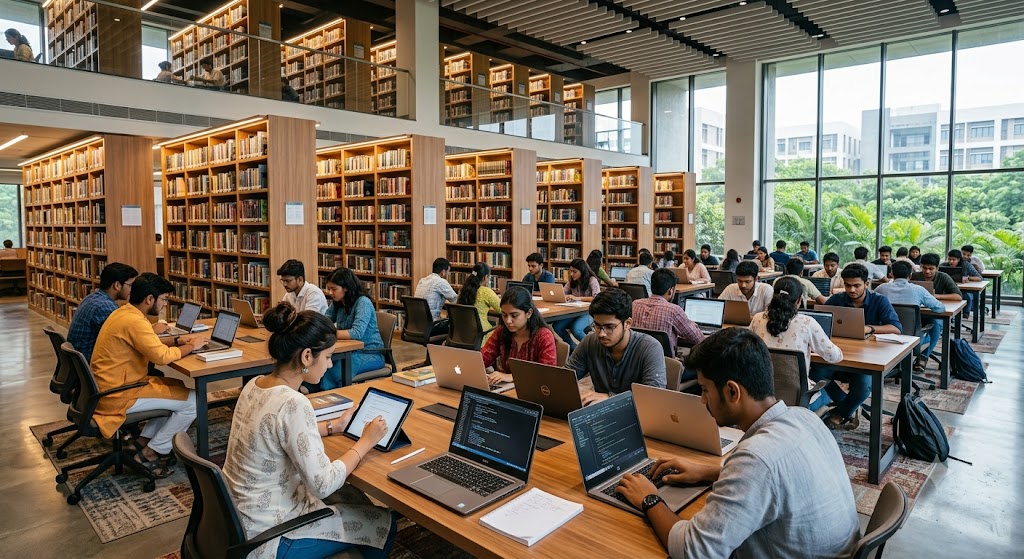
The trajectory of the Indian education system points toward a technology-driven, globally integrated future. As AI-assisted learning tools, virtual laboratories, and adaptive assessment platforms become standard features of Indian classrooms, educational delivery will become increasingly personalized.
Furthermore, internationalization efforts under NEP 2020 are encouraging top-ranked global universities to set up branch campuses in India, while leading Indian institutions (like the IITs) establish offshore centers abroad. This two-way global integration positions India to achieve its vision of becoming a global “Vishwaguru” (knowledge leader) in the coming decades.
Key Takeaways
- Massive Scale: The Indian education system educates over 250 million students across diverse socio-economic backgrounds.
- National Literacy Milestone: India’s overall literacy rate stands at 80.9%, driven by targeted adult and primary education programs.
- NEP 2020 Transformation: Replaces the rigid 10+2 system with a flexible 5+3+3+4 structure focused on critical thinking.
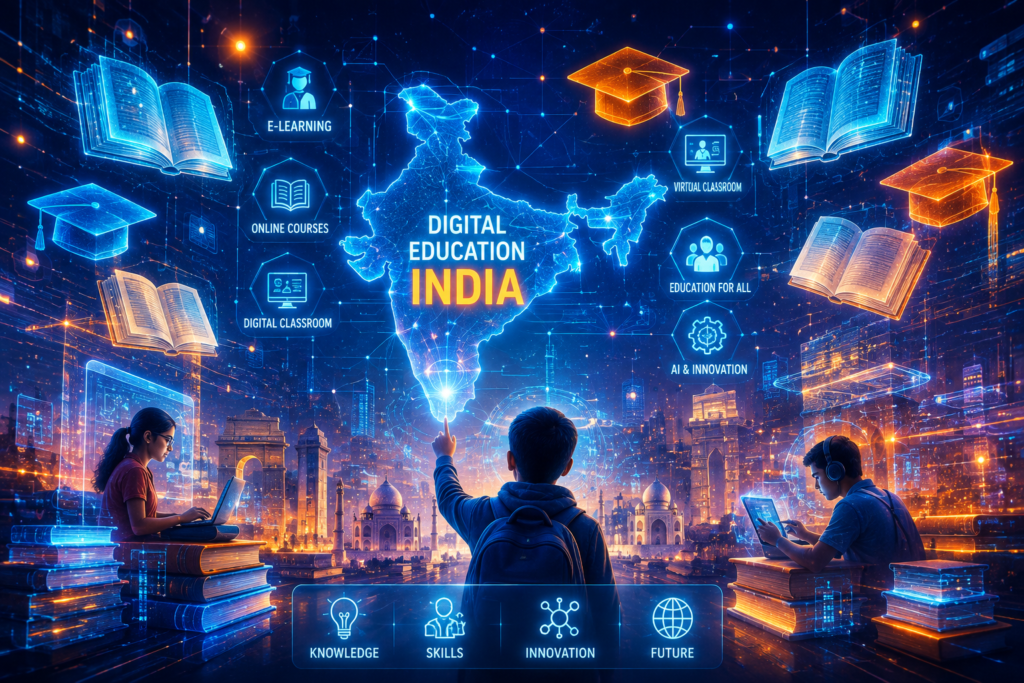
- Digital Leap: Initiatives like EdTech, DIKSHA, and PM eVIDYA are bridging the urban-rural educational divide.
- Skill-Centric Future: Increased integration of vocational education and industry apprenticeships aims to resolve youth unemployability.
Conclusion
The education system in India stands at a historic crossroads. While structural challenges such as infrastructure deficits and quality inconsistencies persist, the ongoing implementation of NEP 2020, coupled with the rapid growth of digital education, is creating unprecedented opportunities for millions of learners.
By continuing to prioritize equitable access, teacher capacity building, and industry-aligned skill development, India is well-positioned to build an inclusive, world-class education system that powers its economic growth and equips future generations for the global knowledge economy.