

Eligibility, Duration, Fees, Salary & Career Opportunities
Did you know that over 70% of business failures occur due to poor cost management rather than low sales volume? In today’s dynamic global economy, modern businesses require financial experts who do more than record past transactions—they need leaders who can optimize expenses, maximize profit margins, and drive strategic expansion
This is where the specialized role of a certified Cost and Management Accountant becomes crucial. Offered by the Institute of Cost Accountants of India (ICMAI), the CMA qualification equips you with high-level expertise in financial planning, managerial decision-making, and cost auditing.

Whether you are a high school student choosing a professional career or a commerce graduate looking to upskill, enrolling in a cost and management accounting course opens doors to top-tier financial management roles across public and private sectors. This complete guide breaks down the full roadmap, eligibility, curriculum, duration, and salary expectations for becoming a cost and management accountant in India.
What Does a Cost and Management Accountant Do?
A certified Cost and Management Accountant is a financial strategist who evaluates operational expenditures, ensures statutory compliance, and crafts budgeting policies to improve corporate profitability.
Unlike conventional accountants who prepare historical statements for external investors, a cost and management accountant works closely with internal executives to steer future strategy.
“Traditional accounting tells you where your business has been; cost and management accounting shows you where your business can go.”
Key Responsibilities
- Cost Auditing & Statutory Compliance: Ensuring adherence to statutory cost records and conducting mandatory cost audits under Indian corporate law.
- Financial Planning & Forecasting: Creating cash-flow forecasts, operating budgets, and variance reports for leadership teams.
- Operational Profit Optimization: Analyzing supply chains and manufacturing costs to eliminate wasteful spending.
- Strategic Pricing Decisions: Determining precise product pricing strategies using marginal costing and differential analysis.
Difference Between Cost Accounting and Management Accounting
Students starting their finance journey often confuse cost accounting with management accounting. While both are integral to the CMA qualification, they address different organizational requirements.
Understanding the difference between cost accounting and management accounting helps clarify how operational data transforms into high-level business strategy.
| Operational Aspect | Cost Accounting | Management Accounting |
| Primary Goal | Determine exact unit costs and control manufacturing expenses. | Assist top management in planning, decision-making, and strategy. |
| Data Type | Focuses mainly on quantitative historical cost data. | Combines quantitative financial data with qualitative operational insights. |
| Target Audience | Plant supervisors, operational managers, and statutory auditors. | C-suite executives, directors, and department heads. |
| Statutory Requirement | Often mandatory under law for specific manufacturing industries. | Purely optional for internal organizational planning. |
CMA Course Levels and Entry Routes
The ICMAI CMA qualification is divided into three comprehensive academic levels:
- Cost and Management Accountant Foundation Level
- Cost and Management Accountant Intermediate Level
- Cost and Management Accountant Final Level
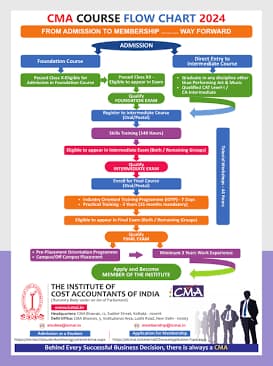
1. Foundation Entry Route (After 10+2)
- You must have passed Class 10+2 (or equivalent) from a recognized educational board.
- Students awaiting their 12th board exam results can register provisionally.
2. Direct Entry Route (After Graduation)
- Graduates in any non-Fine Arts discipline can register directly for the Intermediate Level without taking the Foundation exam.
- Candidates who have passed the CA Intermediate or CS Foundation/Executive level are also eligible for direct entry.
Cost and Management Accounting Syllabus Overview
The cost and management accounting syllabus is designed by ICMAI to provide rigorous coverage of business laws, direct and indirect taxation, corporate financial reporting, and risk management.
| ICMAI CMA SYLLABUS | |
| Foundation (4 Papers) Intermediate (8 Papers) Final (8 Papers) | Business Laws & Accounting Taxation, Auditing & Costing Strategic Cost Management |
Level-Wise Paper Breakdown
- Cost and Management Accountant Foundation Papers:
- Paper 1: Fundamentals of Business Laws and Business Communication
- Paper 2: Fundamentals of Financial and Cost Accounting
- Paper 3: Fundamentals of Business Mathematics and Statistics
- Paper 4: Fundamentals of Business Economics and Management
- Cost and Management Accountant Intermediate Papers (Group 1 & Group 2):
- Group 1: Business Laws and Ethics, Direct Tax Laws and International Taxation, Cost Accounting, Financial Management and Data Analytics.
- Group 2: Operations Management and Strategic Management, Corporate Accounting and Auditing, Financial Management and Business Data Analytics, Management Accounting.
- Cost and Management Accountant Final Papers (Group 3 & Group 4):
- Group 3: Corporate and Economic Laws, Strategic Financial Management, Direct Tax Laws and International Taxation, Strategic Cost Management.
- Group 4: Cost and Management Audit, Corporate Financial Reporting, Indirect Tax Laws and Practice, plus an Elective Subject (e.g., Data Analytics, Entrepreneurship, or Valuation).
Cost and Management Accounting Duration & Practical Training
A major highlight of this professional designation is its structured progression. The typical cost and management accounting duration ranges from 3 to 4 years from admission to earning the full ACMA credential.

Realistic Timeline Breakdown
- Foundation Preparation: 4 to 6 months of focused study.
- Intermediate Preparation: 10 to 12 months for clearing both groups.
- Practical Articleship Training: 15 months of mandatory hands-on experience.
- Final Examination Preparation: 10 to 12 months of intensive study.
Mandatory 15-Month Practical Training
To qualify for ICMAI membership, students must complete 15 months of practical training in a Practicing Cost Accountant firm, a Public Sector Unit (PSU), or a corporate finance department. Additionally, students undergo 140 hours of mandatory Skills Training covering SAP FICO, Microsoft Excel, Data Analytics, and e-Filing.
Official ICMAI Course Fee Structure
Compared to foreign certifications or private MBA degrees, the CMA program offers exceptional value for money.
| Course Level | Official ICMAI Registration Fee | Exam Fee (Per Attempt) |
| Foundation | ~ ₹6,000 | ~ ₹1,200 |
| Intermediate | ~ ₹23,100 | ~ ₹1,400 per group |
| Final | ~ ₹25,000 | ~ ₹1,400 per group |
| Total Official Cost | ~ ₹54,100 to ₹60,000 | (Excluding optional coaching) |
Overcoming Cost and Management Accounting Difficulties
It is important to understand the typical cost and management accounting difficulties candidates encounter so you can build an effective study plan.
Common Student Challenges
- Analytical vs. Theoretical Focus: Subjects like Strategic Cost Management require strong application skills rather than simple memorization.
- Time Management in Exams: The Intermediate and Final papers are lengthy and detailed, requiring consistent mock exam practice.
- Balancing Articleship and Studies: Managing 15 months of full-time work alongside Final exam prep can feel demanding.
How to Overcome These Challenges
- Stick strictly to ICMAI official study materials, Workbooks, and Revision Test Papers (RTPs).
- Develop advanced speed with financial calculators and Excel spreadsheets early on.
- Attempt past 5-year question papers under strict timed examination conditions
Salary and Career Opportunities in India
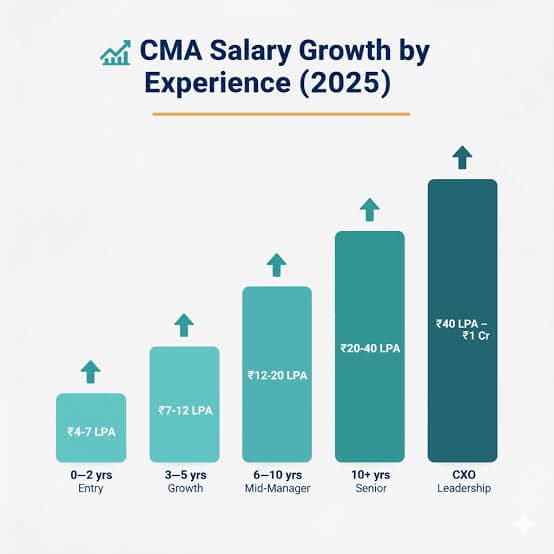
What can you expect to earn after becoming a certified cost and management accountant? Freshers entering corporate finance receive attractive remuneration packages across diverse industries.
Experience-Wise Salary Packages in India
| Experience Level | Typical Job Designation | Average Salary Package (INR/Year) |
| Fresher (0–2 Years) | Cost Analyst, FP&A Associate, Junior Auditor | ₹4.5 Lakhs – ₹8.0 Lakhs |
| Mid-Level (3–6 Years) | Cost Controller, Senior Financial Analyst | ₹9.0 Lakhs – ₹16.0 Lakhs |
| Senior Level (7–12 Years) | Finance Manager, Head of Internal Audit | ₹18.0 Lakhs – ₹32.0 Lakhs |
| Executive (12+ Years) | Chief Financial Officer (CFO), Vice President | ₹35.0 Lakhs – ₹70.0 Lakhs+ |
Top Corporate & Government Recruiters
- Public Sector Undertakings (PSUs): BHEL, IOCL, ONGC, NTPC, Coal India.
- Big 4 & Global Consultancies: Deloitte, PwC, EY, KPMG, Accenture.
- Manufacturing & Tech Leaders: Tata Motors, Reliance Industries, Infosys, FMCG giants.
For more tips on mapping your long-term career goals, check out our guide on [Insert Internal Link to Accounting & Finance Career Trajectories].
Best Practices for Success
- Aim for Both Groups Together: Attempting both groups at Intermediate or Final allows you to take advantage of aggregate mark set-off rules.
- Target PSU Practical Training: Gaining articleship exposure at a major PSU significantly improves your chances during ICMAI campus placements.
- Combine Tech Skills with Costing: Master SAP FICO, Power BI, and Python financial modules to position yourself for senior FP&A roles.
Key Takeaways
- High Corporate Value: The Cost and Management Accountant designation focuses on financial strategy, cost control, and business profitability.
- Clear Qualifications: Entry is flexible—start after Class 12 via Foundation or enter directly after Graduation.
- Affordable Qualification: Total registration fees range between ₹55,000 and ₹60,000.
- Promising Career Trajectory: Starting packages for freshers average ₹5 to ₹8 LPA, with leadership positions exceeding ₹35 LPA.
Conclusion
Building a career as a Cost and Management Accountant is one of the most rewarding decisions you can make in the finance sector. Rather than limiting you to compliance and tax filings, the qualification positions you directly at the decision-making table alongside C-suite leaders.
With its affordable course structure, industry-aligned syllabus, and wide demand across manufacturing MNCs, consulting firms, and government PSUs, the CMA qualification delivers an exceptional return on investment. Start your enrollment with ICMAI today and step into the future of strategic financial management!