
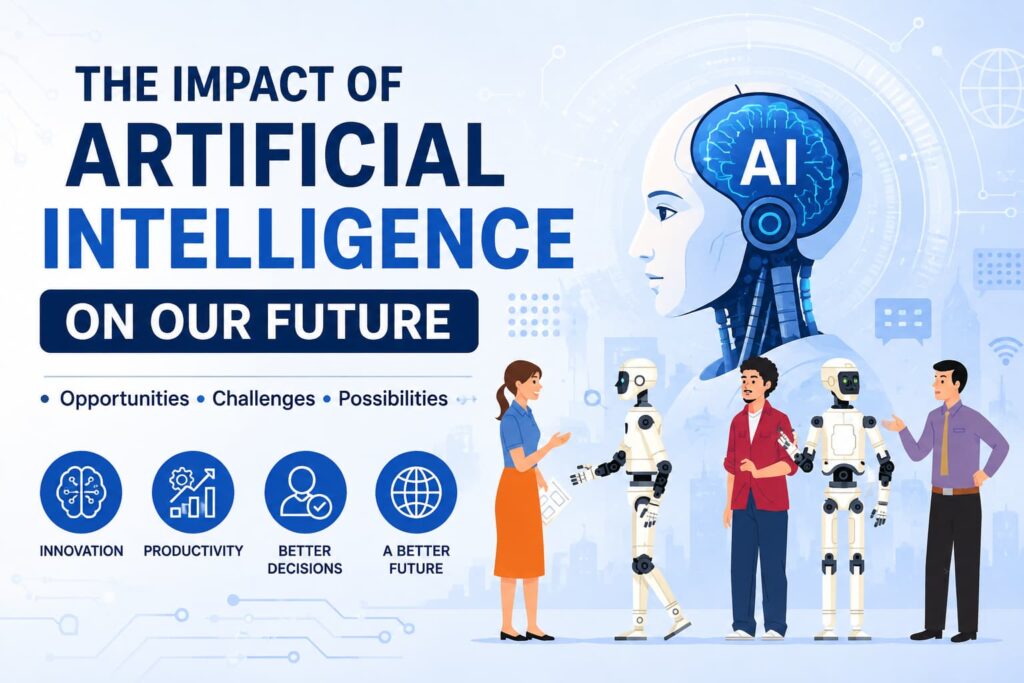

Did you know that over 72% of global enterprises have officially integrated Artificial Intelligence into their core operational workflows? With the global AI market soaring past $539 billion, intelligent systems are no longer just sci-fi concepts—they are actively reshaping healthcare, finance, education, and software development.
Whether you are seeking Artificial Intelligence for beginners or looking to upscale your tech career, understanding this transformative technology is essential. This comprehensive guide covers everything from foundational principles and key subfields to real-world applications, salary insights, and upcoming trends.
What is Artificial Intelligence?
Artificial Intelligence (AI) refers to the capability of a computer system or digital machine to simulate human cognitive functions such as learning, reasoning, problem-solving, perception, and decision-making. Rather than relying solely on rigid, hardcoded rules, modern AI models analyze massive volumes of data to detect patterns, adapt to new inputs, and execute complex tasks autonomously.
“Artificial Intelligence is not about replacing human intellect; it is about amplifying human capabilities and automating repetitive cognitive tasks at unprecedented scale.”
Understanding what is Artificial Intelligence and how does it work begins with recognizing its core goal: creating autonomous software capable of processing unstructured information—such as human text, images, audio, and sensor signals—to perform tasks that previously required human intuition.
History of AI: From Alan Turing to 2026
The journey of intelligent machines spans nearly a century of breakthrough mathematics, hardware innovations, and algorithmic leaps.
Major Eras in AI Development
| Era | Key Milestone | Significance |
| 1950s: Foundations | Turing Test (1950) & Dartmouth Conference (1956) | Alan Turing proposes machine intelligence tests; John McCarthy coins the term “Artificial Intelligence”. |
| 1990s: ML Expansion | IBM Deep Blue Defeats Chess Champion (1997) | Proves specialized machines can outperform top humans in strategic cognitive games. |
| 2010s: Deep Learning | AlexNet Victory (2012) | Deep neural networks break computer vision records, triggering the modern deep learning revolution. |
| 2020s–2026: GenAI & Agents | LLMs & Multimodal AI Agents | Generative models and autonomous AI agents automate complex enterprise workflows and decision-making. |
How Artificial Intelligence Works
At its core, Artificial Intelligence operates through a continuous three-stage workflow: Data Ingestion, Algorithmic Processing, and Output Execution.
The 3-Stage AI Processing Pipeline
| Stage | Process Name | Description |
| Stage 1 | Data Ingestion | Massive datasets containing text, audio, images, or sensor feeds are collected and cleaned. |
| Stage 2 | Model Training & Processing | Neural networks and machine learning algorithms discover patterns and minimize error rates. |
| Stage 3 | Inference & Action | The trained model makes real-time predictions, generates content, or executes autonomous tasks. |
| Feedback | Continuous Optimization | User feedback and new data are fed back into Stage 2 to continuously refine accuracy. |
Types of Artificial Intelligence
To better understand the technology, experts categorize AI using two distinct frameworks: Capabilities and Functionality.
Categorization by Capabilities
| AI Type | Definition | Current Status in 2026 |
| Narrow AI (ANI) | Systems specialized to perform specific tasks (e.g., Siri, ChatGPT, Recommendation Engines). | Widely Deployed across global industries. |
| General AI (AGI) | Hypothetical AI possessing human-level intelligence across all cognitive tasks. | Under Active Research by leading labs. |
| Super AI (ASI) | Theoretical AI that surpasses human intelligence in creativity, wisdom, and technical skill. | Theoretical Concept for future decades. |
Categorization by Functionality
- Reactive Machines: Systems with no memory that respond only to current inputs (e.g., basic chess engines).
- Limited Memory: Systems that analyze historical data to improve over time (e.g., self-driving vehicles).
- Theory of Mind: Next-generation AI capable of understanding human emotions, beliefs, and psychological states.
- Self-Aware AI: Hypothetical systems possessing conscious self-awareness (currently restricted to science fiction).
Key Technologies Behind AI
Modern Artificial Intelligence is powered by an interconnected ecosystem of technical frameworks:
- Natural Language Processing (NLP): Enables machines to read, speak, translate, and synthesize human language seamlessly.
- Computer Vision: Allows software to interpret and analyze visual information from video feeds, satellite imagery, and medical scans.
- Generative & Multimodal AI: Produces original text, code, voice, and high-definition media from simple prompts.
- Robotics & Edge AI: Embeds real-time AI decision-making directly into physical hardware and IoT devices.
Applications of AI & Daily Life Examples
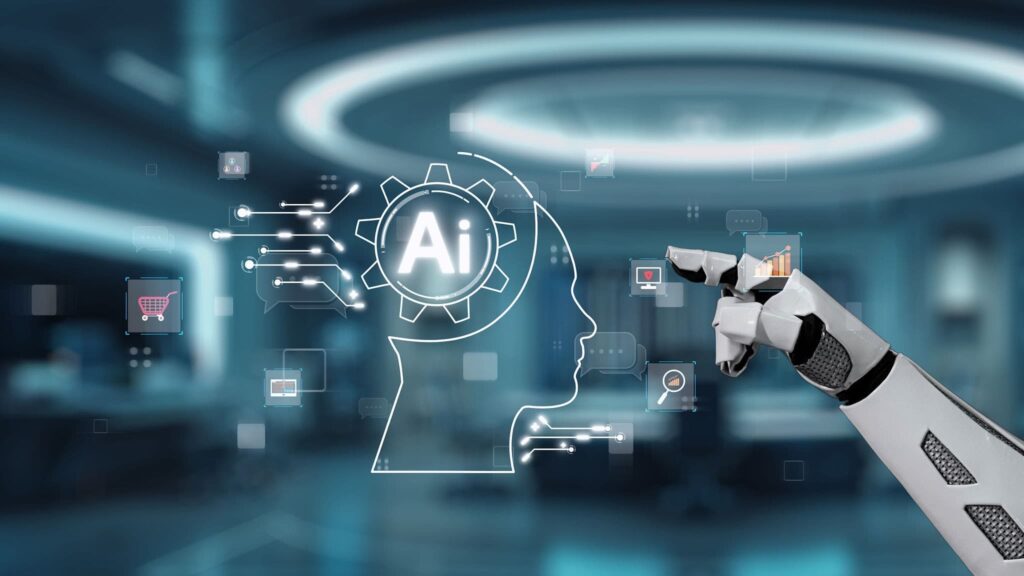
You interact with Artificial Intelligence examples in daily life far more often than you might realize:
- E-Commerce & Streaming: Personalized movie and product recommendations on Netflix, Amazon, and YouTube.
- Financial Security: Real-time fraud prevention algorithms that flag suspicious credit card transactions.
- Smart Assistants: Voice recognition software like Apple Siri, Google Assistant, and Amazon Alexa.
- Navigation & Mobility: Real-time traffic forecasting in Google Maps and autonomous driving systems in Tesla vehicles.
Sector-Wise Applications of Artificial Intelligence
- Healthcare: Early cancer detection using computer vision and automated drug discovery models.
- Banking & BFSI: Automated risk scoring, credit assessment, and algorithmic trading platforms.
- Manufacturing: Predictive equipment maintenance that prevents costly factory downtime.
Benefits of Artificial Intelligence
The widespread adoption of AI stems from the massive operational advantages it provides to individuals and organizations alike.
Core Benefits of AI Adoption
| Benefit Area | Operational Impact | Real-World Application |
| 24/7 Availability | Operates continuously without fatigue or performance degradation. | Automated customer support chatbots & server monitoring. |
| Error Reduction | Eliminates human oversight in repetitive mathematical & data tasks. | Financial auditing, medical imaging, and data entry. |
| Rapid Data Analysis | Processes petabytes of unstructured information in milliseconds. | Fraud detection and market trend forecasting. |
| Automation | Frees human teams from mundane tasks to focus on strategy. | Automated email sorting, code generation, and scheduling. |
Challenges and Limitations (Advantages and Disadvantages of Artificial Intelligence)
While the benefits are immense, evaluating the advantages and disadvantages of Artificial Intelligence requires addressing its critical challenges:
“AI technology is an accelerator. When paired with high-quality data and ethical governance, it drives innovation; when fed biased data, it scales errors rapidly.”
- High Implementation Costs: Training large models demands significant computing power and specialized GPU infrastructure.
- Data Privacy Concerns: Handling sensitive user information raises compliance and security risks.
- Algorithmic Bias: Models can perpetuate or amplify biases present in their training data.
- Job Displacement Concerns: Automation requires workforce reskilling across traditional administrative and entry-level roles.
AI vs Machine Learning vs Deep Learning
A common point of confusion for beginners is distinguishing between Artificial Intelligence vs Machine Learning and Deep Learning. They represent a hierarchy of technology layers:
Comparison Matrix: AI, Machine Learning & Deep Learning
| Technology Layer | Scope & Definition | Key Characteristic | Real-World Example |
| Artificial Intelligence (AI) | Broadest Level: Science of creating smart, autonomous systems. | Mimics overall human intelligence & decision-making. | Autonomous Robots, Self-Driving Vehicles |
| Machine Learning (ML) | Mid Level: Subfield focused on algorithms learning from data. | Learns patterns explicitly without hardcoded programming. | Spam Email Filters, Credit Scoring |
| Deep Learning (DL) | Deepest Level: Subfield using multi-layer neural networks. | Processes raw unstructured data (images, audio, text) automatically. | Facial Recognition, LLMs (ChatGPT) |
Career Opportunities in AI and How to Learn
Driven by rapid enterprise adoption, Artificial Intelligence career opportunities are booming globally, particularly in major technology hubs across India.

Average Artificial Intelligence Salary in India (2026)
Salaries in India vary significantly based on practical skill set, MLOps expertise, and production deployment experience:
- Fresher / Entry-Level (0–2 Yrs): ₹6 LPA to ₹15 LPA
- Mid-Level Professional (3–6 Yrs): ₹15 LPA to ₹28 LPA
- Senior AI / LLM Engineer (7+ Yrs): ₹35 LPA to ₹80+ LPA
Top Roles & Best Artificial Intelligence Tools in 2026
- In-Demand Job Roles: AI Engineer, Machine Learning Specialist, MLOps Architect, NLP Engineer, Computer Vision Developer.
- Best AI Tools in 2026: ChatGPT (OpenAI), Claude 4 (Anthropic), Gemini 2.0 (Google), PyTorch, TensorFlow, Hugging Face, LangChain.
- Popular Artificial Intelligence Courses in India: Post-graduate AI certifications from IITs, IISc, NASSCOM Futureskills, and specialized online learning platforms.
Step-by-Step Learning Roadmap: How to Learn Artificial Intelligence
- Master Core Mathematics: Focus on Linear Algebra, Calculus, Probability, and Statistics.
- Learn Python Programming: Build proficiency in Python libraries (NumPy, Pandas, Scikit-Learn).
- Study ML & Deep Learning Foundations: Practice with PyTorch or TensorFlow on public datasets.
- Build Production Projects: Create end-to-end applications (e.g., LLM chatbots, CV pipelines) and deploy them to cloud platforms.
[Insert External Resource Link to Official PyTorch Documentation]
Future of Artificial Intelligence & Trends in 2026
As we look toward the future, key Artificial Intelligence trends in 2026 point to a transition from simple chat interfaces to fully autonomous, multi-agent ecosystems.
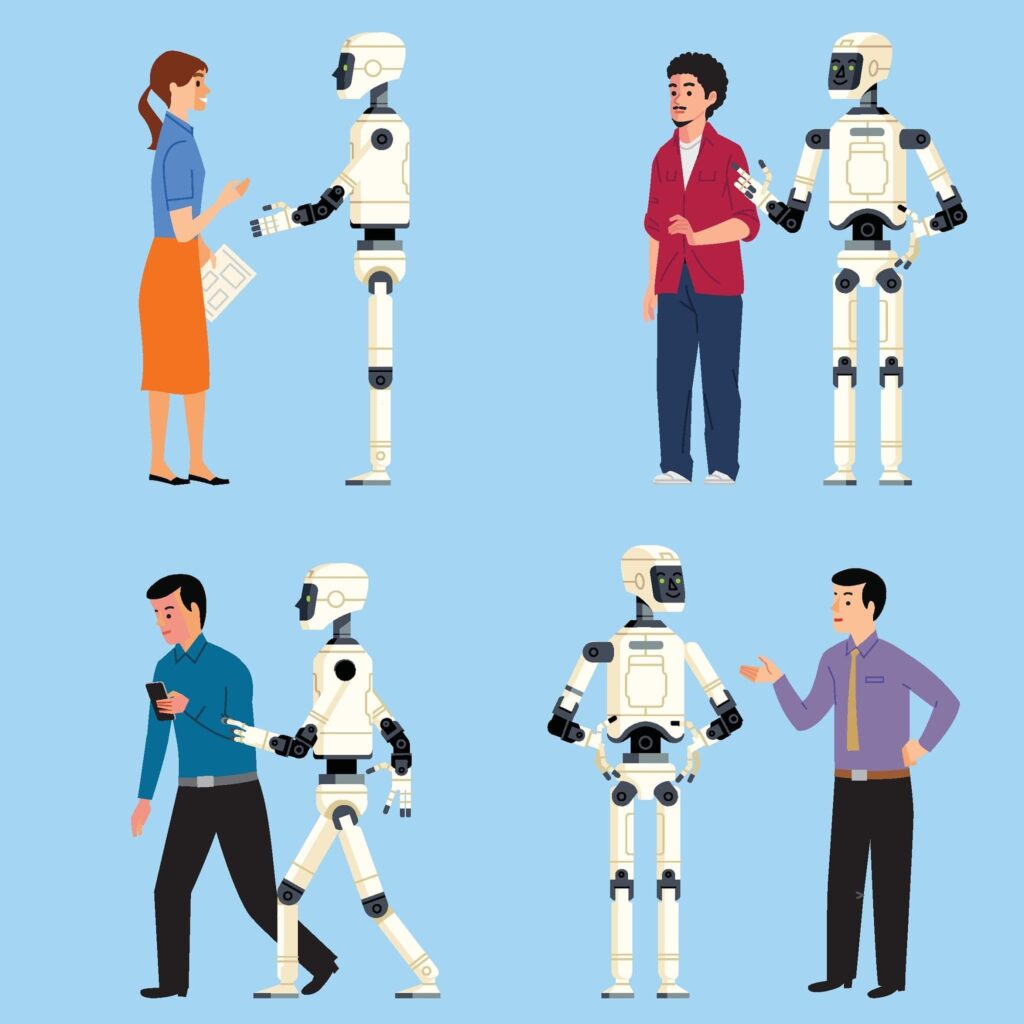
- Agentic AI & Autonomous Workflows: Systems that independently plan, execute multi-step goals, and interact with web APIs without step-by-step human prompts.
- Small Language Models (SLMs) & Edge AI: Highly optimized AI models running locally on smartphones, IoT hardware, and laptops without cloud dependence.
- AI Safety & Regulation Governance: Widespread implementation of global AI safety frameworks, copyright standards, and watermarking requirements.
- Quantum AI Integration: Combining quantum computing architectures with deep learning algorithms to solve complex molecular biology problems.
Video Overview: Understanding Artificial Intelligence
Watch this helpful primer explaining how neural networks and modern AI algorithms function:
[Embedded Video: [https://www.youtube.com/watch?v=2eWuYfzp40g](https://www.youtube.com/watch?v=2eWuYfzp40g)]
Key Takeaways
- Artificial Intelligence simulates human learning and problem-solving through data-driven algorithms.
- Enterprise Adoption: Over 72% of companies globally deploy AI to automate operations and boost efficiency.
- Concentric Subfields: AI is the overarching science, Machine Learning is the learning method, and Deep Learning uses neural networks.
- High Job Growth: AI engineers in India command competitive packages ranging from ₹6 LPA for freshers to ₹80+ LPA for senior experts.
- 2026 Focus: The future centers on agentic AI, localized edge models, and robust governance frameworks.
Conclusion
Artificial Intelligence is no longer a distant technology reserved for research laboratories—it is the foundational engine driving digital innovation in 2026. From automating routine administrative tasks to accelerating scientific breakthroughs, AI is reshaping how humanity works, solves problems, and creates value.
By building a strong foundation in Python, machine learning algorithms, and real-world deployment skills, you can take full advantage of the expanding career opportunities in this field. Explore AI learning resources today, experiment with modern tools, and start building your future in technology!